| Passive Solar Precedent Studies |
|
SOLAR PRECEDENT STUDY
01 - POLYSPORTIVE ESTERRI
|
|
|
KEY
POINTS
- Low cost, low maintenance - 70% of energy acquired by passive solar design - Reflecting shutters - increase solar gain by 20% + act as insulation at night - Natural daylighting + natural ventilation reduce capital maintenance costs - Passive solar design adds 14% to the cost of the building in exchange for energy saving in the long term |
|
|
|
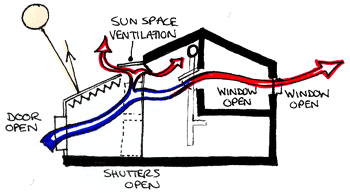
DETAIL ANALYSIS  Winter Day The sunspace to the front of the building receives direct solar radiation and reflected radiation from the photovoltaic cell. This is self powered, raising or lowering itself according to the intensity of the light.  Winter Night The shutter closes to retain trapped heat in the sunspace. Solar energy retained in the storage wall heats the space. Trickle ventilation is provided by underfloor duct and a fan at high level |


|
SOLAR PRECEDENT STUDY
02 - BOEGEHUSENE
|
|
|
KEY
POINTS
- Low cost - 3 Climate Zones for different seasons - Attached sunspace with system of shutters and blinds cuts energy consumption by 40% - Warmed solar ar redistributed to cooler parts of house by simple system |
|
|
|
DETAIL ANALYSIS  Detailed Section Detailed section through junction between fully glazed (single) sunspace and fibre-cement sheeted roof.1000 |



|
SOLAR PRECEDENT STUDY
03 - AM LINDENWALDE
|
|
|
KEY
POINTS
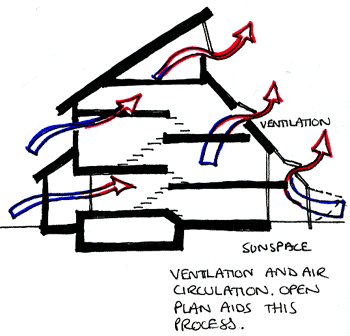
- Curved terrace with sunspace attached to South side - Split level floors increases daylight penetration and promotes circulation of heated solar air throughout the house - Houses cost less than those of a similar traditional size due to design and construction savings. |
|
|
|
DETAIL ANALYSIS  Terrace plan The sunspace larger South facing elevation permits more solar energy to be collected in the large sunspaces and less lost through the reduced North facing wall. FLOOR PLANS  Ground Floor  First Floor  Second Floor  Third Floor |


 Sundays, Living House in Geilsdorf |
 Supermarket, Greenwich |
 Les Cochevis |
 Ecohome, Bristil, UK |
 Sun Valley House, Idaho |
 Passivhaus Darmstadt, Kranichstein |
 Wohnhaus in Tubingen |
 Passivhausscheibe |
 Waterfall House, Wales |
 House in Regensburg |