| Textual Analysis and Abstract Model | |
Economics of Signs and Space - Scott Lash and John Urry, Published 1994 A summary of Chapter 9 - Time and Memory
Time is a social, not a natural phenomenon - time is distinguished between societies, with elements such as weeks varying in length from 3 to 16 days. Most societies now have agreed to follow the same divisions but the divisions in time we all follow are abstract, not natural. As this development has occurred, days have shifted from being organised by task with a sundial as a background element to the exploitation of mechanically divided labour time. One of the constrains of capitalism was the limiting effect the rulers put on lengths of working days and as such the working hours became denser and encouraged improvements in technology: 'The great improvements made in machines of every kind have raised their productive power very much. Without any doubt, the shortening of the hours of labour……..gave the impulse to these improvements. The latter, combined with the more intense strain upon the workman, have had the effect that at least as much is produced in the shortened working day…..as was previously produced during the longer one. (Quoted in Marx 1976: 540) Time separates work from the context of work - time becomes the measure
of work instead and employees are seen as temporal subjects, having
an orientation to time as well as being disciplined by time. This change
in attitudes started to happen between the 16th and 18th centuries with
the burgeoning cash economy and the strives of the Puritan society to
make everyone abide by a day of rest on the Sabbath, with six days of
work in between. Social conflict became focused around time as units
of clock time became measures of work, hence the term "time is
money", although this can be interpreted in a different manner
and it is worth noting that time, unlike money, cannot be stored or
saved - every moment is a movement towards death. People vary in their
ability to use time effectively, hence the modern ideas of time management
and time and motion studies. Time becomes a limited resource when it's
the very thing you haven't got enough of to the extent that men will
pay to delegate work in order to free leisure time. Adam considers the concept of time as a resource in contrast to Giddens who puts time at the heart of contemporary social theory, believing social activity is organised temporally and spatially. Heideger approaches from a more distant view point, understanding 'being' as fundamentally temporal, going on to clarify that the nature of time, and thus of being, should not be concerned with the means by which it is measured. Time can instead be defined by event paths - individuals moving through time-space meet at 'stations' and comprise 'bundles'. Individuals pursue 'projects' that have to use the inherently limited resources of time and space. There are 'capability constraints', such as the need for regular sleep or food, and coupling constraints, which constrain activities that are undertaken with others, at least for part of the time. There is the concept of co-presence availability, the degree to which
people are available to one's social milieu - this has seen dramatic
advance over the last two centuries through the development of transportation
technologies and the subsequent separation of communication from transportation.
Our understanding of time is still evolving however, with major discoveries of the last century reshaping our views of natural time. Einstein demonstrated that there is no fixed time - time is a local, internal feature of the system of observation. He also showed that time and space are fused into four dimensional entities, curved under the influence of mass. Hence time in nature is now intrinsically temporal as time is most definitely directional - the arrow of time. Thus we have summarised a notion of time that is non-spatialised, non-reversible, multi faceted, and where no strong distinction is drawn between the times of nature and those of humans. Hence we have a distinction between the present and the here and now - there is always a movement of time that we are intrinsically linked to - time is lived, not captured. The last portion of the chapter deals with time as a social organiser,
and our view within this social milieu as a limited one within a larger
picture. Generally we deal with the duree of daily time, the diasein
of life time and the longue duree of history. However, these time scales
relating to our existence fall between the micro seconds of quantum
physics and the imperceptibly long periods involved in studies such
as astronomy. Clock time lies in the middle, and it has been clock time
that has been the organising principle of modernity. To the extent that
we are passing into the post modern, to disorganised capitalism, then
we are moving to time as glacial or evolutionary and to a time that
is instantaneous. Nowotny: Our time space interactions become increasingly complex as the worlds societies move towards a society with pockets of stretching to accommodate co-presence availability. There is now no fashion - but fashions, no choice, only choices. Hence there is a profound change upon what we imagine as instantaneous time - the time space paths of individuals are completely desynchronised, which can be seen in the importance now laid upon pockets of 'quality time' with key individuals or groups among our social interactions. This emptying of time and space establishes a single world - a single
community - a 'we'. The consequence of this is a re-evaluation of the
larger picture - the longue duree of the future, as we start to think
of the planet as a home for 'us'. The instantaneous is informing our
understanding of evolutionary time - our position in history and place. |
|
| ABSTRACT
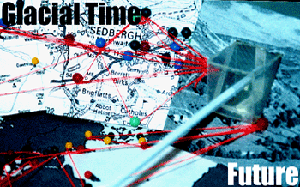
MODEL The model explores the relationship between event and place, looking at different ideas of co-presence availability in different time cultures and architecture's role in enabling our responses to these. |
|
 |
|
 SHELL AVAILABILITY IN CHORLTON |
 PULP AVAILABLITY IN SEDBERGH |
| Time and place separated architecture - architecture is building for specific time-culture - place is event | |
 Adjaye Assoc. family home superimposed on Daisy Nook Country Park |
 The Farnsworth House superimposed on Manchester's Albert Square |
The model works on a number of levels. The different areas of mapping represent similar scales of availability within the immediate areas around the two sites of Beech Road, Chorlton, and Nursery Lane, Sedbergh, which extend now to certain points around the world using digital information. The points on the map represent events - happenings in time in a specific location that constitute events and thus place. The paths represent daily event paths, with certain advantages and disadvantages of inhabitation of either area evidenced in choice or repetition. MICRO Intervention as enabler of co-presence availability. More or Less? The response from either site cannot be identical and give the same awareness of local events - of course the ideas of local are massively different because the choice and quality of event are radically different. The micro scale of the house - the pulp and its materiality thus become the inhabitant's language with the local. Any intervention is a possible connection with the world, from a singular 'info-point' upwards. This instantaneous time thus enables us to see glacial time, and thus appropriate a response to both the availability of instantaneous time and the wider environmental issues involved in glacial time. Hence the void between the instantaneousness of micro-clock time and the natural / clock time which maps our daily event paths becomes more significant in the two areas. Where the choice is limited events take the route of least resistance meaning little change occurs over a large time scale, unless the change is forced and is then seen as drastic. In the city context, the maps of our days have moved through clock-defined activity because of the availability of individuals moving through time and space. These people meet at stations, comprising bundles. As such the choice is available at any particular time to undertake any particular activity. Hence the event paths of a day rarely tend to be the same, as the emphasis is upon choice and proximity of events rather than specific co-ordinated events. MISO At a street level this impetus means a regular turnover of specific location based activity as the city dictates success or failure. Looking from a wider viewpoint the rate of change at something approaching glacial level is also much more rapid in Chorlton, with the area moving from farming land through low density residential, industry based retail and now through leisure based retail. In contradiction, the land at Sedbergh appears to have remained fairly static oscillating slightly between forest and residential clearing and back to unused wooded land. Change at this level does have certain effects on the human mind as the text explores. Our perception of the future is changing towards our understanding of the near-present - the rate of change is such that it is instantaneous time dictating the events of tomorrow, not the rules of glacial time. Hence in Sedbergh ideas of security of place may need different considerations than the site in Chorlton. MACRO The city as co-presence enabler is thus evidenced in availability at micro level, choice and freedom at miso level and anonymity at city level. The city also acts as climate protection. Areas within the city, especially in built up residencies such as the Chorlton site gain protection from extreme wind conditions due to the buffering effect of surrounding buildings, and experience a more stable temperature range due to stability of the air but more detrimental pollution levels. |
|